In the 21st century, science and technology are the central pillars of any nation. Take the example of the world’s most developed countries: their development has been made possible by scientific and technological advancement and innovation.
We do not need to go far; the importance of information technology and innovation in pursuing modernization and high-quality development is evident in neighbouring country China. Today, it has become a world power powerhouse in science and innovation.
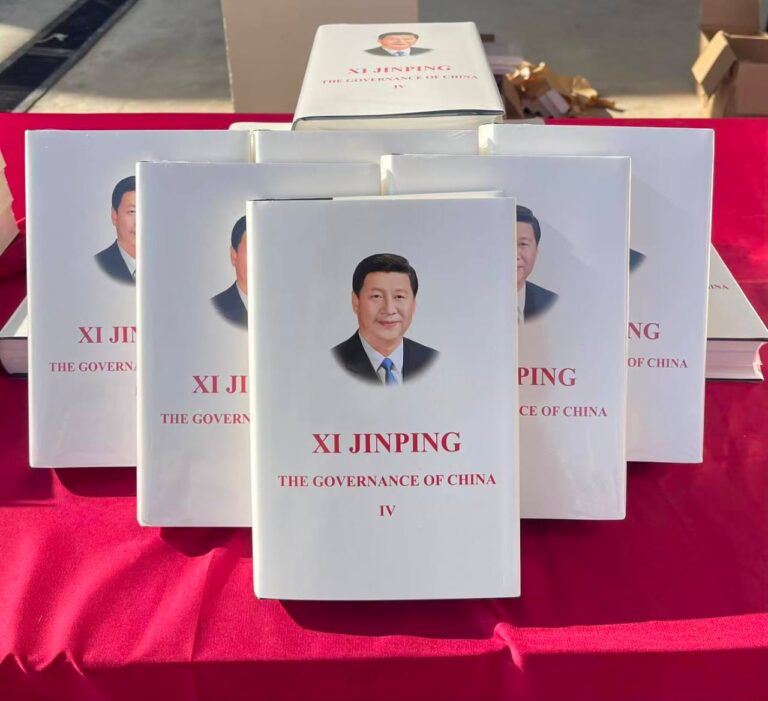
The article “Build China into a Sci-Tech Powerhouse,” mentioned in the book ‘Xi Jinping: The Governance of China V,’ focuses on the same. In 2024, Xi urged “to strengthen top-level design and overall planning and expedite high-level sci-tech self-reliance to realize the strategic goal of building a strong country in science and technology by 2035.”
This is very realistic, as when the priority is set in top-level design, it is easy to implement effectively at all levels.
Over the years, we have been aware that China has made breakthroughs. China is rapidly advancing in Artificial Intelligence (AI) with applications in facial recognition, autonomous vehicles, voice assistants, and smart cities. It has also achieved significant milestones, including the launch of the world’s first quantum communication satellite. From space programs to semiconductor manufacturing, from the world’s fastest supercomputers to the most sophisticated high-speed rail networks, remarkable advances have been made across various fields of science and technology.
In our context, Nepal’s science and technology landscape is gradually evolving.
As Xi mentions in the chapter, “Breakthroughs are in basic frontier research, taken new strides in strategic high-tech fields, achieved new results in high-quality development driven by innovation, opened up new prospects in the reform of the sci-tech system, and made new progress in sci-tech opening-up and cooperation with the rest of the world.”
With this, China has become today’s leading power in the field, with other countries following in its footsteps. Nepal has experienced slow growth and development over recent years; however, there is a drive for government initiatives, international collaborations, and local innovation.
Amid such, some sectors, such as agriculture, renewable energy, and information and communication technology (ICT), have significant scope for further growth. Today, there is an expansion of internet connectivity across urban and rural areas, digital literacy, e-governance, and digital financial services such as mobile banking across many sectors, which is a positive development.
China adopted the experiences and paved the way for independent innovation, innovation-driven development, deepening reform, a virtuous cycle of education, sci-tech development, and talent cultivation, as well as sci-tech opening-up and cooperation for the benefit of humanity, the book reads. This is a realistic measure, as its focus on innovation, government support, and large-scale investments has propelled it to the forefront of cutting-edge science and technology globally.
As Chinese President Xi suggests, there is also a need to promote the deep integration of sci-tech innovation with industrial innovation to facilitate the development of new, high-quality productive forces.
Since there are no modern huge industries in Nepal, there are many small-scale industries. Thus, there is a need to foster and develop future industries and use new technologies to transform and upgrade traditional industries.

Nepal has a large youth population, accounting for a significant share of the total population. According to the 2021 census, there are 12.4 million young people in Nepal, which presents immense opportunities for national development. Young people are agents of change, bringing energy, creativity, and a desire for progress across fields such as education, health, and other sectors. However, we lack an integrated reform in educational, scientific, and talent institutions. To effectively manage them, we need to cultivate a large, well-structured, and high-calibre team of innovative talent.
There should be science and technology cooperation initiatives and, as Xi suggests, broadening channels for exchanges and collaborations at both governmental and non-governmental levels. There is a massive opportunity for learning, trade, and cooperation with other countries, especially China, as well as for research collaborations with international institutions.
We can learn from China in many ways, including supportive policies, consistent investment in R&D, the development of innovation ecosystems, and the cultivation of talent focused on practical, industry-oriented solutions. Throughout the book, we learn that China’s sustained focus underscores the importance of a long-term vision and consistent effort in achieving technological leadership.
It is essential to build a nation that is strong in science and technology. Learning from China in science and technology can provide valuable insights and strategies for other countries aiming for technological advancement.
Rajesh thapa
Center Committee Member, the socialist party of Nepal