By Li Rui, People’s Daily
With a few taps on her phone, Ms. Cui, a resident of Shanghai’s Pudong district, ordered fresh deep-sea large yellow croaker. Within 24 hours, a box of the freshly harvested fish — tender and fragrant when cooked — was delivered to her doorstep.
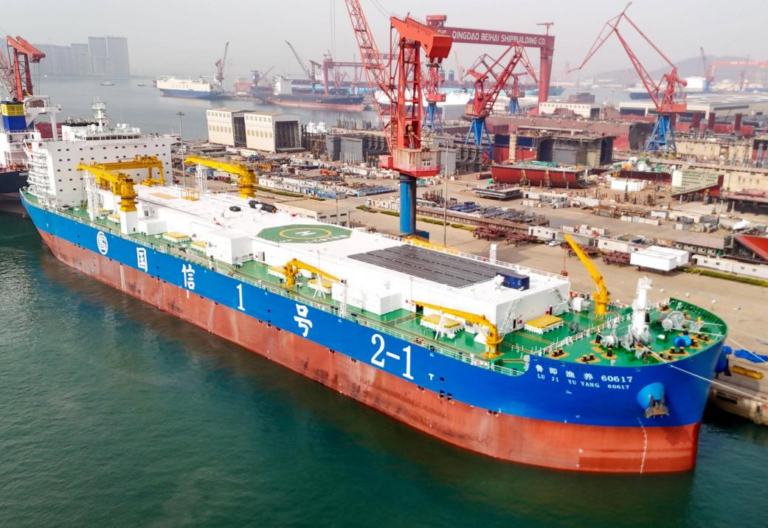
These croakers were raised off the coast of Zhoushan, east China’s Zhejiang province, aboard Guoxin No.1 2-1, the world’s first 150,000-ton smart aquaculture vessel. As an upgrade to the earlier 100,000-ton Guoxin No.1, this vessel began trial operations on April 17 this year. It welcomed more than 1 million juvenile croakers in early May and, by November, had successfully harvested over 46,000 croakers in a single catch.
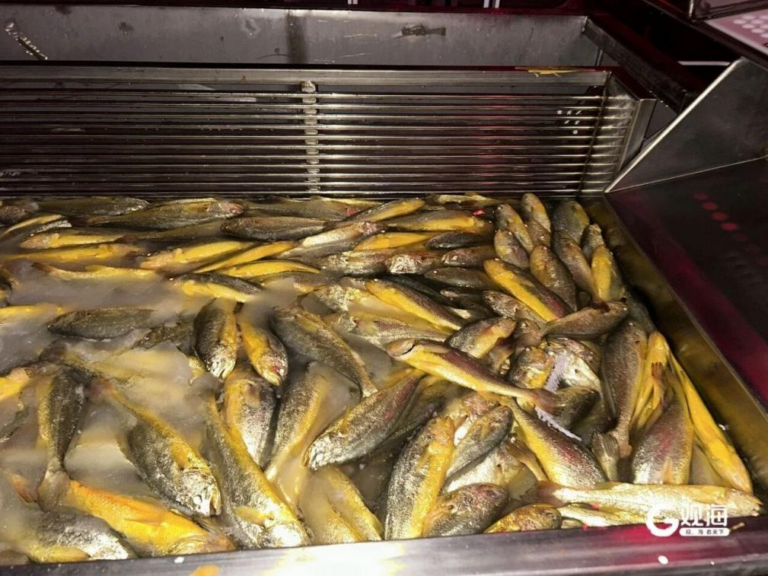
Photo shows yellow croakers harvested from Guoxin No.1 2-1, the world’s first 150,000-ton smart aquaculture vessel. (Photo from Guanhai News)
“Wherever the water is the best, that’s where we go,” said Sun Linlin, production director of the vessel. Equipped with a mobile, ship-based tank system, the vessel follows ideal temperatures, water quality, and ocean currents, much like herders seeking the best pastures, to ensure the fish remain in a stable and natural environment.
Inside the vessel’s aquaculture monitoring room, a large digital screen presents real-time data on current velocity, dissolved oxygen, water temperature, and feed volume. “Each tank is equipped with an advanced environmental control system,” Sun explained. “Although enclosed, the water remains in continuous circulation, supporting natural purification and keeping the fish active and healthy.”
This “ocean ranch” includes 15 standard aquaculture tanks for large-scale commercial farming; four circular raceway pools that serve as both exercise zones and transition areas for mid-sized juveniles; and 22 experimental tanks for feed comparison, drug-sensitivity tests, and other research. The total water volume exceeds 96,000 cubic meters.
How many people are required to operate such a massive facility? Just 35 staff members, and only 16 are directly involved in fish breeding.
“The entire vessel is supported by an integrated, high-efficiency farming control system,” Sun said. More than 200 cameras and 2,000 sensors make up an intelligent monitoring network that enables remote oversight and targeted management. “Take feeding as an example. Each aquaculture tank requires 1 to 1.5 tons of feed per day. Thanks to automated loading, rail-guided distribution carts, localized storage bins, and scheduled delivery, just two staff members can manage feeding operations for the entire vessel each day.”
From fry stocking and automated feeding to harvesting and processing, nearly all key steps aboard Guoxin No.1 2-1 are mechanized. The vessel’s mechanization rate exceeds 90 percent, automation has increased by 45 percent, and nearly 30 percent of farming decisions are made by intelligent systems, resulting in a 20 percent reduction in labor costs.
“In total, the vessel incorporates more than 160 technological breakthroughs and innovations across functional design, aquaculture systems, new-energy applications, and integrated information platforms,” Sun noted.
This innovation ecosystem is catalyzing broader upgrades across the broader marine fishery sector. On the feed side, specialized formulations and intelligent software enable precision nutrition. In logistics, coordinated ship-to-shore cold-chain systems ensure delivery within six hours for 500 kilometers and within 15 hours for 1,000 kilometers. In processing, stable, high-quality raw materials from the vessel support a range of products from chilled fresh fish to ready-to-cook and premium prepared foods, meeting diverse market demands.
The bumper harvest of yellow croaker from Guoxin No.1 2-1 marks just the beginning. The recent delivery of Guoxin No.1 2-2, designed primarily for high-value cold-water species such as salmon and trout, signals continued expansion. Once all three vessels in the Guoxin No.1 series reach full production, their combined annual output is expected to exceed 10,000 tons.
“With large-scale aquaculture vessels, we’re no longer constrained by weather or geography. We can raise southern species in northern waters and northern species in southern waters, achieving seasonal balance in production. This industrialized approach significantly enhances efficiency and resource utilization, transforming the deep sea into a sustainable ‘blue granary,'” Sun said.