By Chang Qin, People’s Daily
In Beichi village, Yichuan county, Yan’an, northwest China’s Shaanxi province, neat rows of newly planted, dwarf high-density apple orchards now stretch across the hillsides. Five years ago, villager An Wenzhong made a difficult decision: cutting down his mature apple trees. The old varieties were aging and earned little, but his bold move marked a shift from inefficient farming to modern agriculture.
Indeed, what An cleared away was an inefficient past; what he planted was the future of modern agriculture.
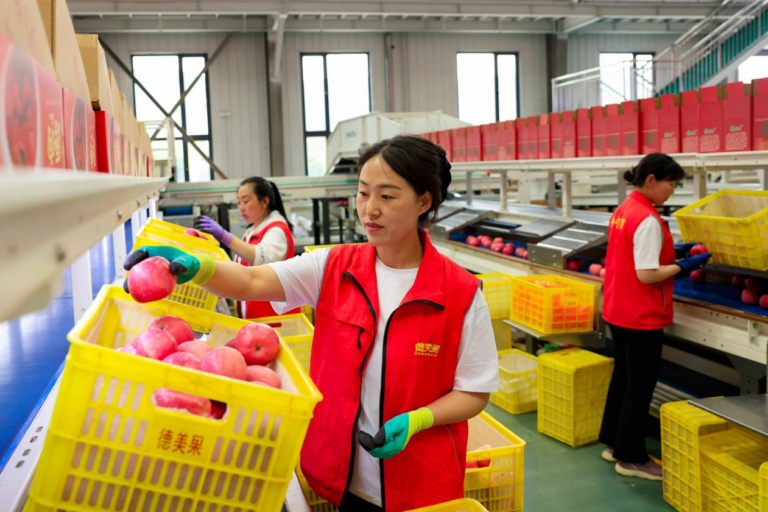
The decision has since yielded tangible results. Standing in his new orchard, An did the math: the original 20 mu (1.33 hectares) of old orchards generated an annual output of 140,000 yuan ($19,797), while the revamped 16 mu of new orchards can yield as much as 320,000 yuan a year once they reach full production.
This transformation reflects not only the upgrading of the Yan’an apple industry, but also a leap in development quality. It reveals the core logic behind China’s poverty alleviation: shifting from giving relief handouts to fostering self-reliance through industrial development.
A longstanding challenge in global poverty reduction has been escaping the cycle of persistent poverty despite continuous aid. China’s solution lies in a development-oriented approach — treating economic growth as the fundamental means to address poverty.
Industrial development is central to rural revitalization. Across China, regions have turned local resources into thriving industries: wood ear mushrooms in Zhashui (Shaanxi), daylilies in Datong (Shanxi), and lychees in Maoming (Guangdong). By the end of 2024, each of China’s 832 counties that had shaken off poverty had cultivated two to three leading industries, providing people lifted out of poverty with stable income channels.
Practice shows that industrial development is the fundamental solution to poverty reduction. Turning local resources into competitive strengths creates sustained momentum for economic growth and improved livelihoods.
To further unleash endogenous dynamism, it is also essential to establish and improve benefit-linking mechanisms, ensuring that people share in the fruits of development.
In Ma’anshan village of Chifeng, north China’s Inner Mongolia autonomous region, mountain grapes have been designated as the leading industry. The village has established an operational model that integrates companies, cooperatives, production bases, and farming households. This industrial chain has created employment opportunities for many villagers.
Across the country, various models including order-based agriculture, profit-sharing arrangements, and equity cooperation, are being explored to forge communities of shared interests between farmers and business entities, allowing farmers to share in the value added by rural industries.
China has emerged as a global exemplar of inclusive development—narrowing regional disparities, improving income distribution, strengthening social safety nets, and creating opportunities. To address challenges like fragmented rural supply chains, effective collaboration between markets and government enhances efficiency and vitality. In Liuzhou (Guangxi), for instance, government support through standardization, planning, and industrial parks propelled the local snail rice noodle industry from street food to a thriving sector.
This approach — empowering communities through localized industries supported by strategic policy — has redefined poverty alleviation, turning once-overlooked resources into engines of prosperity.
Meanwhile, market players have sharpened product quality and used e-commerce and livestreaming to expand the reach of snail rice noodle. Extensions of the industrial chain such as snail farming and the cultivation of bamboo shoots, green beans, and wood ear mushrooms, have helped lift farmers out of poverty and into prosperity.
Allowing the “invisible hand” of the market and the “visible hand” of government work in better coordination is a distinctive strength of China’s economic development.
Across vast rural areas, traditional farming bases are upgrading into modern agricultural industrial parks, advancing from single-product production toward integrated rural industrial systems that combine grain, cash crops, and feed; coordinate agriculture, forestry, animal husbandry, and fisheries; link production, processing, and sales; and integrate agriculture with culture and tourism.
In addition, in building a modern industrial system, innovation chains, industrial chains, supply chains, and value chains are being seamlessly aligned. Scientific and technological innovation is guiding industrial innovation, while industrial upgrading, in turn, propels technological iteration.
A proactive government provides direction, ensures stability, and creates platforms, while an effective market allocates resources, unleashes vitality, and drives innovation, together forging a powerful force for high-quality development.
As a Chinese saying goes, “If you give a man a fish, you feed him for a day. If you teach a man to fish, you feed him for a lifetime.” China has not only eliminated absolute poverty through its own development, but has also actively carried out international cooperation on poverty reduction. By sharing and promoting technologies such as Juncao cultivation and hybrid rice, China has helped other developing countries foster industries and explore poverty reduction paths suited to their own national conditions.
Development has no final destination. As China embarks on a new journey, continued efforts to refine and strengthen distinctive rural industries will further solidify the foundations of poverty alleviation, enhance its sustainability, and widen the path toward common prosperity.