By Wang Junling
China is home to the world’s largest high-speed railway, expressway, and postal express delivery networks, as well as the world’s biggest and most extensive digital infrastructure. This increasingly modernized infrastructure system has supported rapid economic and social development, improving public services and enhancing everyday life.
Looking ahead to the next five years, how will China advance its infrastructure development?
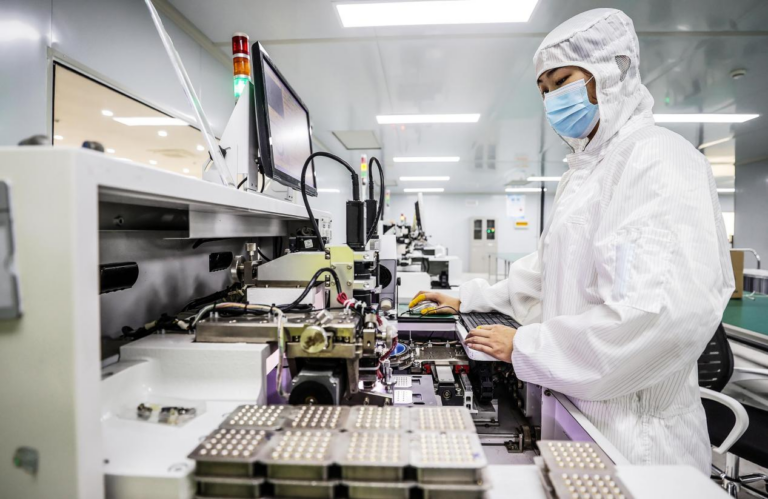
A worker manufactures 5G optical communication components in a workshop of a company in Huaibei, east China’s Anhui province. (Photo/Feng Shufeng)
According to the recommendations for formulating the 15th Five-Year Plan, new types of infrastructure will be built with appropriate forward planning; information and communication networks, the national integrated computing network, major science and technology infrastructure, and other key systems will be further developed and used intensively and efficiently; traditional infrastructure will be upgraded and retrofitted with digital and intelligent technologies.
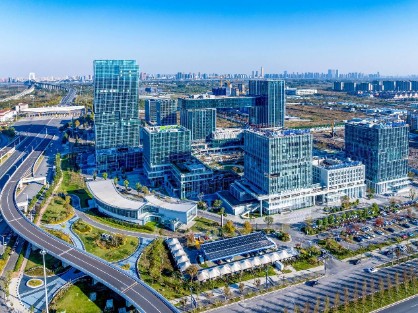
Photo shows an intelligent computing industrial park in Wuhu, east China’s Anhui province. (Photo/Tao Haijin)
This marks the first time a Five-Year Plan recommendation explicitly incorporates the concept of “appropriate forward planning” for new infrastructure.
What does this concept entail, and how will China implement it?
As technologies such as artificial intelligence, blockchain, 5G, and digital twin become deeply embedded in daily life and economic activity, China has made significant strides in developing information infrastructure, integrated infrastructure, and innovative infrastructure. These new foundations underpin the digital economy, accelerate the modernization of traditional infrastructure, and support scientific and technological innovation.
According to Huang Qunhui, a research fellow at the Institute of Economics, Chinese Academy of Social Sciences, many sectors, including scientific research, transportation, energy, water conservancy, and communications, face strong demand for digital, intelligent and green upgrades amid a new round of scientific and technological revolution and industrial transformation. Among these, digital-intelligent infrastructure such as next-generation communication base stations, high-performance computing equipment, and ultra-large storage systems has become central priorities.
Zhang Liqun, a research fellow at the Development Research Center of China’s State Council, highlights the public good nature of infrastructure, in contrast to the exclusivity of ordinary commodities. In this context, “appropriate forward planning” implies that government investment in emerging infrastructure, such as communication networks, computing capabilities, and scientific research platforms, must stay ahead of evolving societal needs to ensure public services are both proactive and resilient.
“For example, the growth of emerging industries and the upgrading of traditional industries rely on services like real-time communication and artificial intelligence enabled by traditional infrastructure,” Zhang added. “Government-led investments must anticipate demand to close critical gaps in a timely manner.”
Infrastructure development is a complex undertaking that encompasses policy, funding, planning, and technology, requiring coordinated, well-designed implementation. According to Xiang Aibing, director of the transport integration and innovation research center at the Institute of Comprehensive Transportation of China’s National Development and Reform Commission, despite tremendous progress, China still faces structural weaknesses in new infrastructure and in meeting the higher standards of quality development and public expectations.
Challenges persist in central and western regions and in special zones, where full coverage of gas pipeline and mobile communication network is lacking. Rural areas still struggle with “last-mile” connectivity, and integration across transport, energy, and digital infrastructure remains insufficient.
“The term ‘appropriate’ reflects the need for infrastructure development to align with the pace of economic and social development, while ‘forward-looking’ emphasizes its guiding and enabling function,” Xiang noted.
“During the 15th Five-Year Plan period (2021-2025), China must ensure that the supply of new infrastructure — its capacity, regional distribution, technological sophistication, implementation schedule, and scale — keeps pace with evolving development needs, creating a virtuous cycle of supply and demand,” Xiang added.
The resulting improvements in public services and growing market opportunities are drawing increasing attention from enterprises.
Li Qian, chairwoman of Net Zero, a tech firm based in northwest China’s Xinjiang Uygur autonomous region, said: “New infrastructure creates substantial opportunities for business expansion. We are making sustained investments, with appropriate forward planning, in computing power infrastructure to position ourselves for rising demand.”
Lunkr Technology (Guangzhou) Co., Ltd., the world’s first commercial company supporting the IETF multilingual email standard, provides digital solutions for clients in Thailand, Indonesia, South Africa, Zambia, and other countries. Wu Xiucheng, executive vice president of the company, noted that advancing new infrastructure with appropriate forward planning during the 15th Five-Year Plan period is a strategic move that enables digital industry growth and fosters new technologies and business models.
“Going forward, we will scale up our AI-driven products and services to better capitalize on emerging opportunities in email systems and cybersecurity,” Wu added.