By Lyu Xiaoxun, People’s Daily
How do mega infrastructure projects become popular tourist destinations?
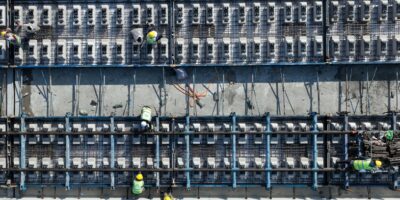
At the Huajiang Grand Canyon Bridge in southwest China’s Guizhou province, the world’s longest-span and tallest bridge, is drawing significant visitors. Beyond its engineering marvel, it features a 1,000-square-meter glass observation hall, along with low-altitude skydiving and bungee jumping facilities, turning infrastructure into a thrilling tourist attraction.
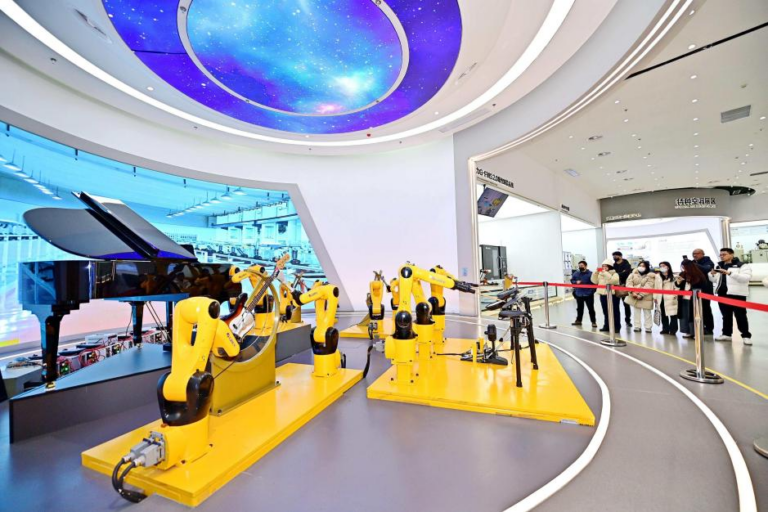
Tourists watch a “robotic band” play music in an exhibition hall of industrial tourism of a home appliance enterprise in Ganzhou, east China’s Jiangxi province. (Photo/Zhu Haipeng)
How do frontline production sites transform into experiential learning spaces?
At the Jiangnan Shipyard in Shanghai, visitors collaborate to assemble ship models and explore vessel construction and dismantling processes — an immersive, educational activity welcomed by students and teachers alike.
Across China, traditional “Keep Out” signs are being replaced with “Welcome” mats as industrial tourism gains momentum. Increasingly, innovative and experiential tours are redefining public engagement with industry, offering deeply informative and sometimes romanticized journeys through China’s industrial heartland.
What makes industrial tourism so appealing? And why are consumers drawn to industrial aesthetics?
Industrial tourism captivates not merely through landscapes but by revealing the narrative of a major manufacturing nation, including its challenges, achievements, and transformation. It invites visitors to engage with the tangible legacy of industrial progress.
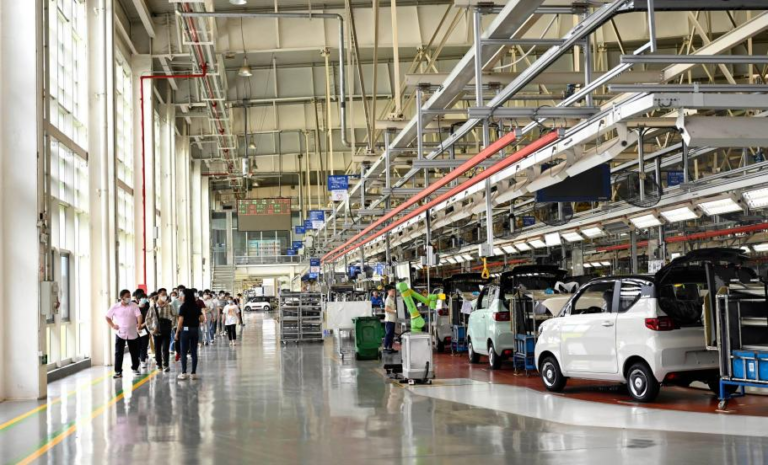
Tourists visit a workshop of Dongfeng Liuzhou Motor Co., Ltd. in Liuzhou, south China’s Guangxi Zhuang autonomous region. (Photo/Li Hanchi)
At the Yumen Oilfield in northwest China’s Gansu province, a key site of revolutionary tourism, visitors can smell crude oil, feel its texture, and trace the formation and extraction process, gaining a visceral understanding of the dedication and pioneering spirit of generations of oil workers.
At the Wenchang International Aerospace City in south China’s Hainan province, envisioned as the country’s first commercial spaceflight, crowds of “rocket chasers” gather to witness launches up close, experiencing China’s steady march toward becoming a leading nation in aerospace and science and technology.
Unlike traditional sightseeing, industrial tourism offers a unique perspective on industrial innovation and technological transformations. It chronicles China’s evolution from catching up to taking the lead, from overcoming critical technological “bottlenecks” to closing technological gaps. China’s national industrial heritage sites and tourism bases serve as living archives of perseverance and progress, reflecting the enduring spirit of the Chinese people.
Industrial tourism goes beyond novelty; it fosters meaningful engagement with the realities of manufacturing and modern life. Immersive experiences allow visitors to understand not only how products are made but also the ingenuity driving their creation.
At the Tsingtao Brewery Museum in east China’s Shandong province, the popular live-action show “The Awakening Brewer” often sells out morning sessions. As visitors follow the narrative, they sample beer-yeast bread and malt tea, experiencing an enjoyable fusion of culture, craftsmanship, and flavor.
At the Sanmen Nuclear Power Plant in Taizhou, Zhejiang province, visitors can wear uniforms and operate a simulated control panel. This hands-on activity offers a rare glimpse into the stability and safety protocols of China’s nuclear energy sector, deepening public appreciation for advanced energy infrastructure.
Factory tours and workshop visits satisfy public curiosity and the growing appetite for experiential learning. They expand horizons, provide leisure opportunities, and spark imagination and innovation. For operators, interactive and accessible programs enrich service offerings, enhance public understanding of industrial processes, and strengthen brand recognition and social credibility. As destinations and visitors engage more closely, a virtuous cycle emerges, fueling growth in the cultural and tourism sector.
Beyond showcasing products and infrastructure, industrial tourism also communicates development philosophies and cultural values. It promotes new pathways to high-quality development that prioritize ecology, conservation, and green, low-carbon practices. These experiences allow visitors to connect with both China’s collective memory and its vision for the future.
In Fanshan township of Cangnan county, Wenzhou, Zhejiang, ecological restoration of abandoned mines has been integrated with the revitalization of miners’ villages and industrial sites. Last year, the township’s tourism revenue reached approximately 44 million yuan ($6.21 million), exemplifying the principle that “lucid waters and lush mountains are invaluable assets.”
At the Meishan Iron and Steel industrial cultural tourism zone in Nanjing, Jiangsu province, successive ultra-low-emission upgrades have reduced energy consumption per ton of steel for three consecutive years. The addition of ecological features, such as micro-wetlands and fish ponds, has attracted native wildlife like egrets and black kites, drawing over 500,000 visitors annually. The park demonstrates that “rust belts” can be reimagined as “scenic belts.”
Today, production lines are not only engines of industry but also key assets in tourism development. Leveraging China’s extensive industrial heritage, and supported by coordinated efforts from both government and industry, industrial tourism is well-positioned to unlock new momentum for sustainable growth and expanded domestic consumption.